

Bone density, inhabitation, and why the kettlebell is no longer about looking a certain way
What the body is doing while we sleep

What the body is doing while we sleep
She said the number was fine.
She said it the way you say it’s fine when you mean something more complicated than fine.
We were at her kitchen table on a Saturday afternoon. Her tea had gone slightly cold. She’d just had her first DEXA scan, and when I asked how it went, she paused in a way that told me the number wasn’t actually what she was sitting with.
“The bones look okay,” she said. “But the woman at the imaging center told me about what happens after the final period. And I just. I didn’t know any of it.”
She’s 52. Healthy by most definitions. Walks four days a week. Eat enough. Sleep most nights. And she had no idea that bone loss accelerates meaningfully in the years following menopause. No idea that the window before the final period is actually when a lot of the protective work can happen. No idea that most women don’t find out any of this until something breaks.
I didn’t know either. Not really.
I’d seen it mentioned in passing, in articles I half-read while doing something else. I knew calcium was involved somehow. I knew weight-bearing exercise was good. But I didn’t know the timeline, or the scope, or how quietly it all starts while we’re looking at something else entirely.
The imaging center gave her a pamphlet.
She’d driven home alone with it in the passenger seat.
There’s something about that image that I keep returning to. The pamphlet. The quiet drive. The number was fine, but the afternoon wasn’t quite fine, because she understood something now that she’d had no way to understand before.
This is how so much of the midlife body information arrives. Late. Alone. In a packet of papers.
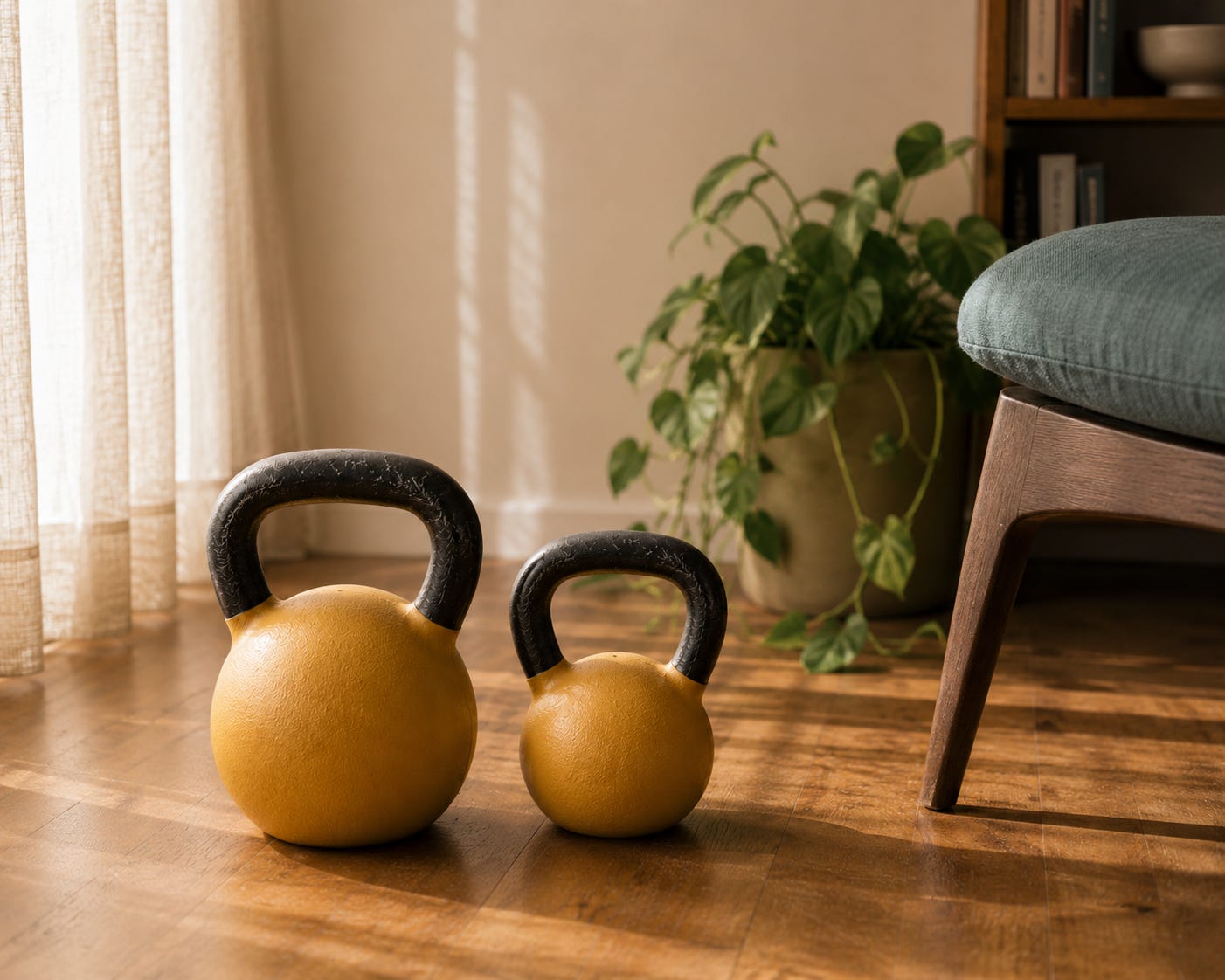
I went home and looked at the kettlebells in the corner of my home office.
I’ve had them for two years. I use them inconsistently. When I have used them, I’ve mostly thought in the old vocabulary: tone, shape, metabolism, arms that look a certain way in photos. I am not proud of this. That vocabulary was the only one I was given. It was the water I swam in for thirty years, and it had nothing to do with what my bones were quietly, continuously doing.
The thing I’m sitting with now is this: the reps are not about how I look.
They are about what holds the next forty years.
That is not a metaphor. It’s a physical fact. The load, the impact, the resistance, the pull of muscle against bone, asking the body to stay dense, to keep building, to hold its own structure. Not because anyone is watching. Not because summer is coming. Because I will be in this body for a long time, and the work I do now is the quiet infrastructure of that long time.
I don’t say this to frighten anyone. I say it because, genuinely, it helped me.
It changed the question.
Instead of will this give me the body I want, the question became will this keep the body I have. Those are very different questions. One is about performance. One is about inhabitation.
Inhabitation. That is the word I keep landing on.
Not optimization. Not getting ahead of the aging, or reversing the clock, or earning the right to eat the bread. Just being in the body that is here and learning, slowly and imperfectly, what it needs to stay.
I picked up the kettlebell on Monday and did twenty minutes. I am not doing this because I have become someone who is disciplined about fitness. I am doing it because my friend sat across from me with cold tea and told me something that landed differently than any fitness article ever has. Because she wasn’t talking about aesthetics. She was talking about structure.
The body is doing things while we sleep, while we are distracted, while we are managing everything else on the list. It is building and maintaining and asking, quietly, for a certain kind of attention.
Not grand attention. Not a whole program. Just something consistent. Something that treats the body as a place you plan to live for a long time, not a project you’re always almost finishing.
The reps are not about anything except staying.
Maybe that’s enough of a reason.
For me, right now, it's the first time a reason like that has actually felt real.
The Recipe
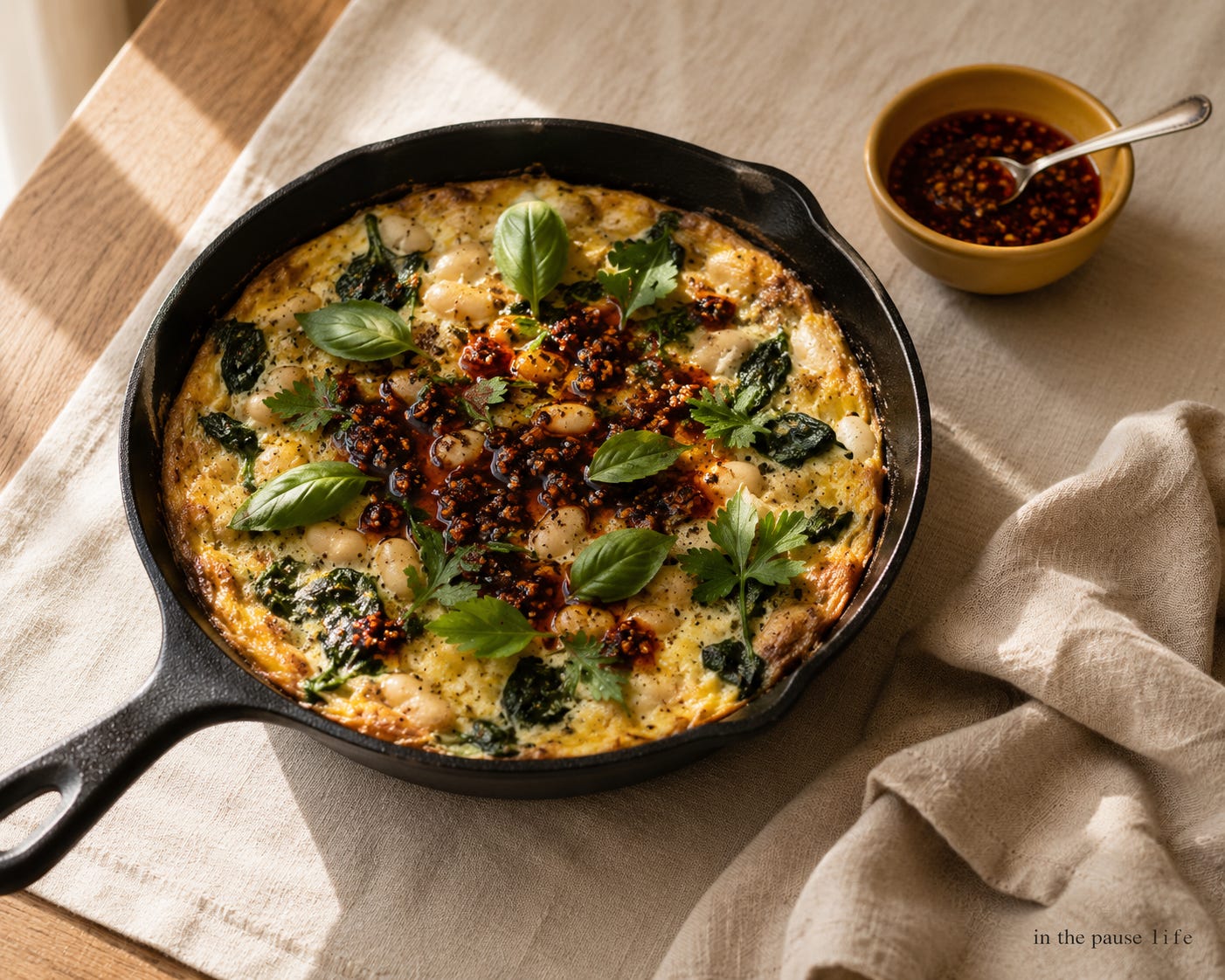
White Bean and Spinach Frittata
Serves 2 — ready in 20 minutes
A savory, protein-rich skillet dinner for the nights you want something warm, grounding, and a little alive.
6 large eggs 1 can white beans, drained and rinsed 2 large handfuls baby spinach 1 tablespoon olive oil ½ teaspoon fish sauce (or salt, if preferred) 1–2 spoonfuls chili crisp, for finishing Fresh herbs to serve (Thai basil, cilantro, or flat-leaf parsley) Fresh black pepper
Preheat the oven to 375°F.
In a bowl, whisk eggs with fish sauce and several turns of black pepper.
Warm olive oil in an oven-safe skillet over medium heat.
Add white beans and spinach. Stir gently until spinach just wilts, about 2 minutes.
Pour egg mixture into the skillet. Let the edges begin to set, about 2 minutes.
Transfer skillet to the oven and bake for 10–12 minutes, until the center is just set.
Rest for 2 minutes.
Spoon chili crisp generously over the top and scatter with fresh herbs.
Serve straight from the pan. Eat it slowly. This one deserves it.
Notes from the Pause
Eggs deliver roughly 6 grams of complete protein each, meaning all nine essential amino acids your muscles need to pull against bone during resistance training. This frittata gives you 25–28 grams in one sitting.
White beans add plant-based protein and soluble fiber, both of which support blood sugar steadiness, something that shifts noticeably during perimenopause.
Fish sauce adds depth, not fishiness. It’s the quiet reason restaurant food tastes the way it does. One small splash changes everything.
Chili crisp adds heat, crunch, and a little ceremony. Food that tastes like something is not a luxury. It’s a reason to keep eating well.
The Sip
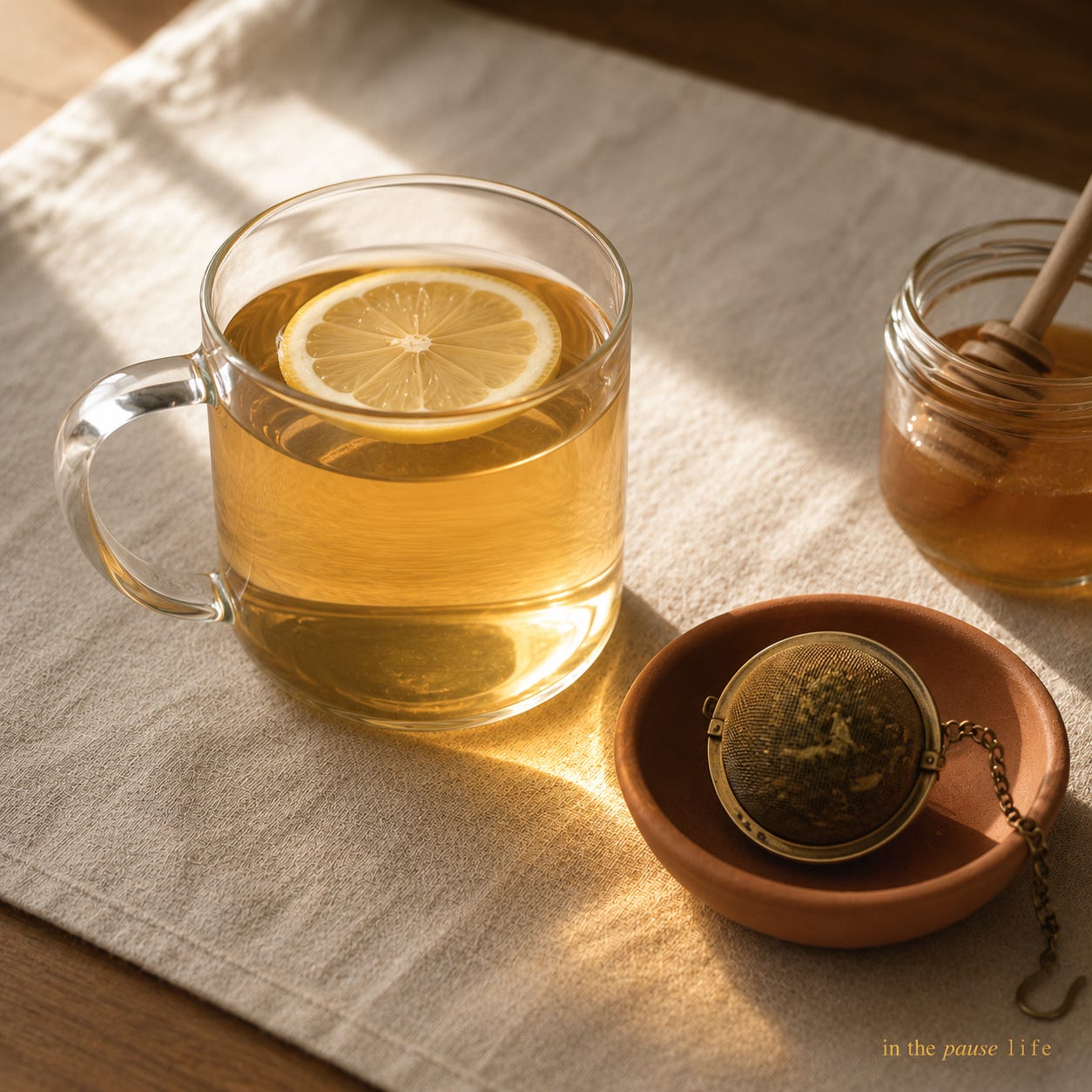
The Quiet Build Nettle and lemon tea — Yield: 1 cup
1 heaped teaspoon dried nettle leaf, or 1 nettle tea bag 1 cup water, just off the boil (around 200°F) 1 thin slice fresh lemon 1 small spoonful honey, optional
Heat water to just below a full boil.
Place the nettle leaf in a tea infuser or drop the tea bag directly into your mug.
Pour the water over. Cover the cup with a small plate to hold the heat in.
Steep for 8 minutes. This longer steep matters more with nettle than with most herbs.
Remove the infuser or bag. Drop the lemon slice into the cup.
Add honey if you want it. Pour into a cup you enjoy holding.
Notes from the cup
Nettle leaf carries calcium, magnesium, and iron in a form the body can absorb. Not a supplement, but not nothing either, especially during a time when mineral retention starts to matter more.
The 8-minute steep pulls more mineral content than a quick dip. Covering the cup while it steeps keeps the volatile plant compounds from escaping with the steam. It is worth the extra four minutes.
The lemon slice adds a small amount of vitamin C, which supports mineral absorption. A quiet, practical reason to keep it in the cup rather than on the side.
Many women in perimenopause and postmenopause find warm, mineral-forward teas a gentle complement to the calcium and magnesium their bodies are working harder to hold. This is one easy place to start.
The Movement
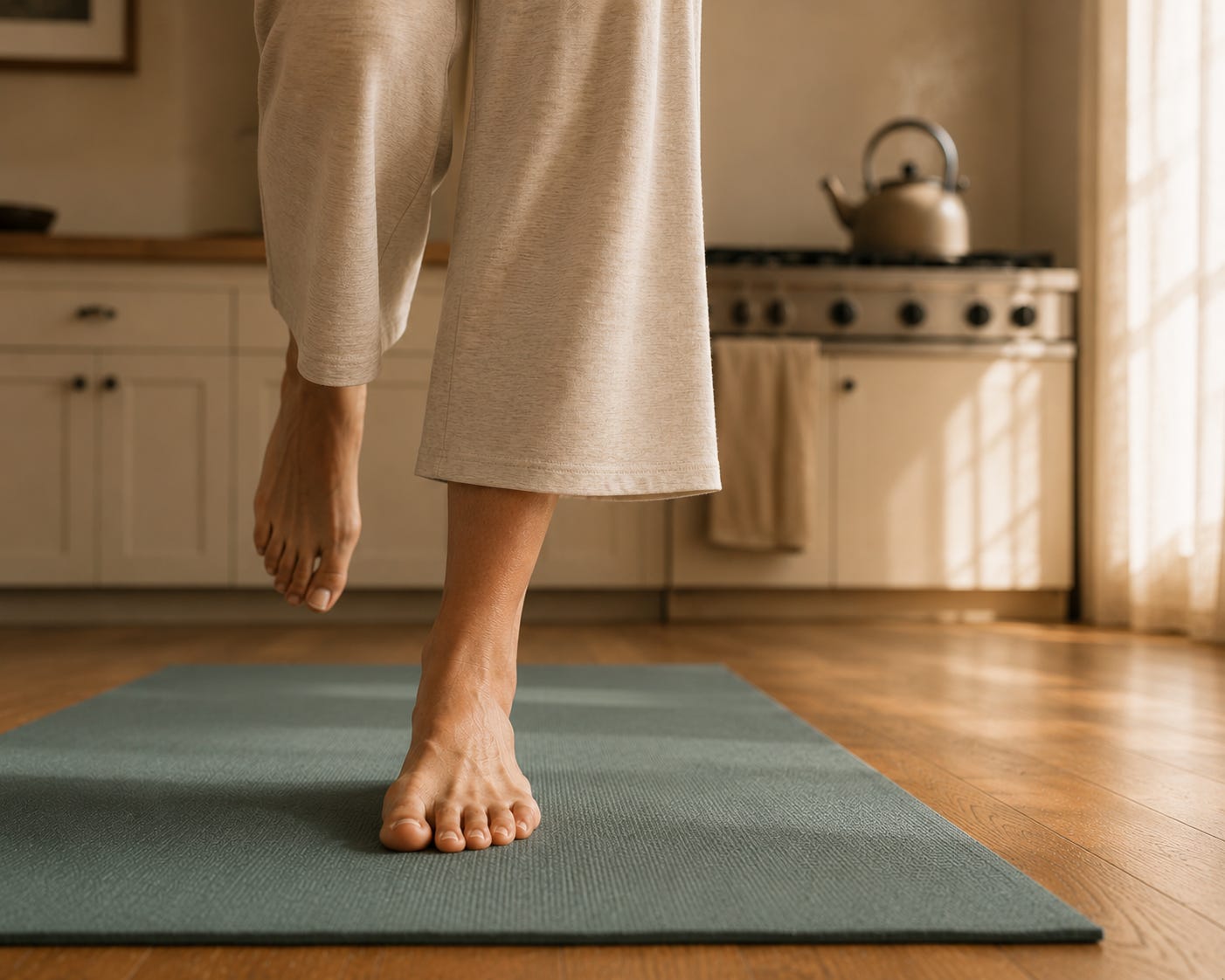
Single-leg balance. Sixty seconds, no equipment, done while the kettle heats.
Stand near the counter if you want a hand nearby. Shift your weight onto one foot and lift the other just slightly off the floor. Soft knee, long spine, eyes fixed on one still point across the room. The wobble is the work. Your hip, ankle, and deep core are all negotiating, and that negotiation is what builds the kind of structural strength the body needs for the long haul.
One minute on each side.
It sounds like almost nothing. It is nothing. Do it daily for a month and notice how the wobble changes. On warm days, take it outside. The uneven ground of a patio or a patch of grass asks more of the ankle than a flat floor does, and the sun on your arms while you stand there is its own kind of medicine.
The Home Touch
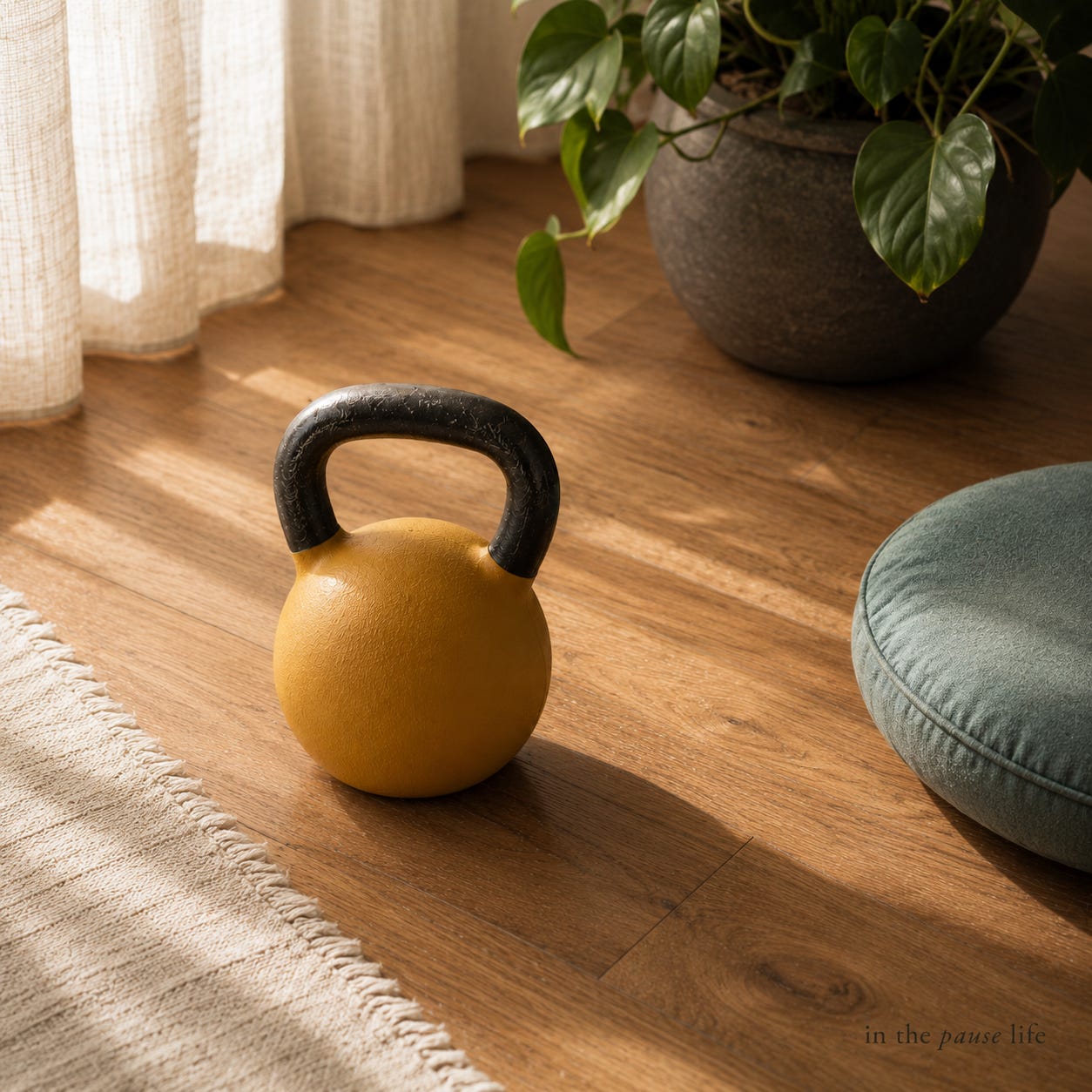
Move the mat, the kettlebell, or whatever your movement object is, out of the corner.
That is all. Just move it somewhere you will walk past it. Visibility is one of the main triggers. The corner is where intentions go to rest quietly until next month. The middle of the room, the spot beside the bed, the patch of floor in front of the window where the morning light comes in, that is where they occasionally become action.
On a good week, the kettlebell moves outside entirely. Onto the back step, into the driveway, wherever the air is. You do not need a gym. You need the thing to be somewhere you will actually see it.
If something in this one landed for you, hit reply and tell me. I read everyone.
And if you are new here, I made something small for the weeks when the body feels unfamiliar. Five Permission Slips, free, at slips.inthepauselife.com.
In The Pause Life arrives every Friday. Written for women in perimenopause, menopause, and post-menopause. Slow, warm, true.
If someone forwarded this to you and you would like to receive it directly, you can subscribe below.
I’ll be here next Friday. Same time, same quiet.
Come sit with me,
Tew Green
In The Pause Life
Transition·Tend·Strengthen·Savor·Become