
The easy plant kept dying. The rare ones thrived.
What the marble queen pothos taught me about finding what actually grows in your particular life.

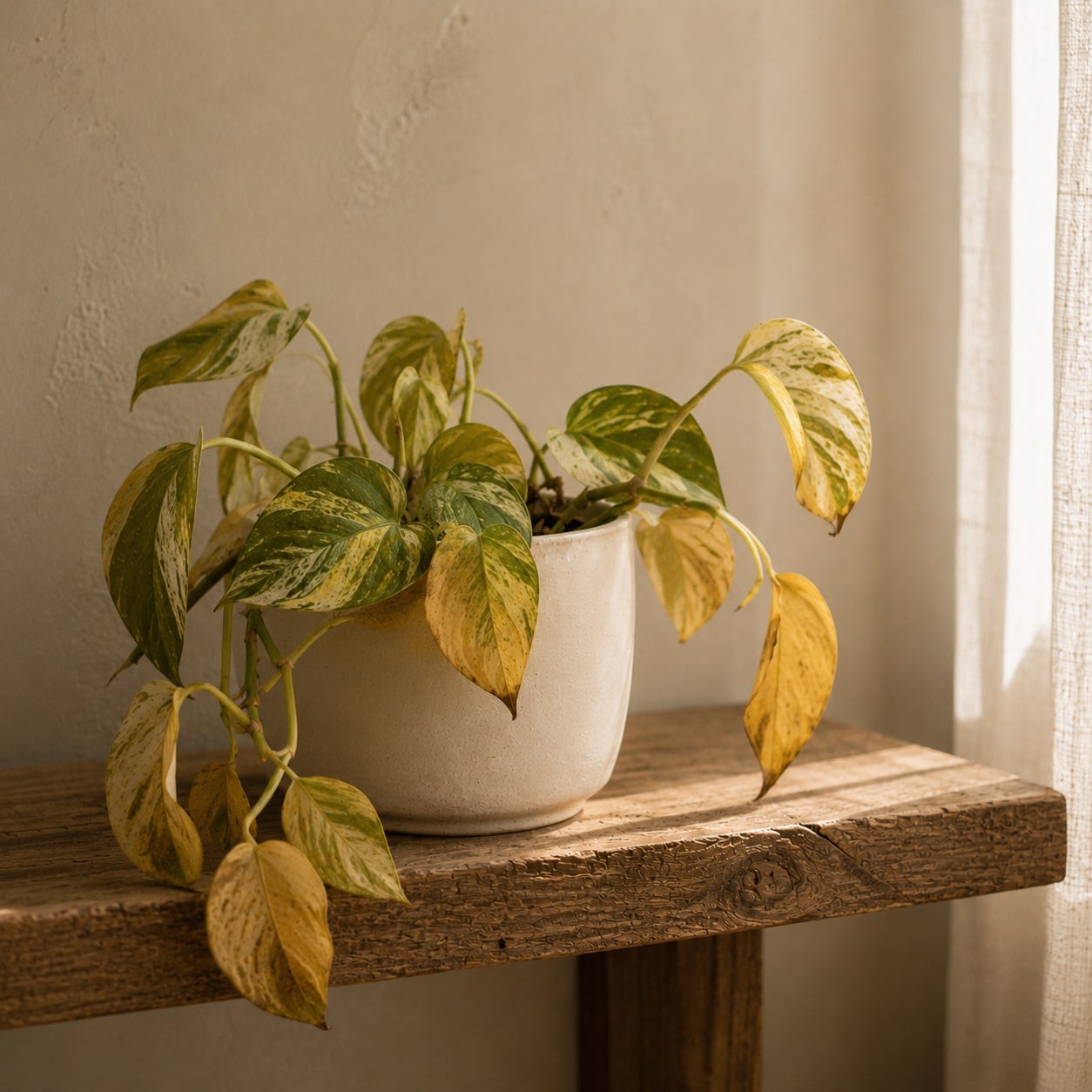
I have been buying houseplants.
Not in a decorator’s way. Not as a project. Just quietly, one by one, tucking them into corners of my home the way you add a sentence to something you are still figuring out.
And then I bought a marble queen pothos.
The marble queen is supposed to be easy. It is on every beginner’s list, every “you can’t kill this” roundup, every gift guide for people who think they have a black thumb. Tolerates low light. Forgives missed watering. Practically grows itself.
Mine did not grow itself. Three times. Three plants, three attempts, three quiet yellowing endings I could not explain.
I did not feel like a failure, which surprised me. I just noticed. And kept going.
Because here is what I had not expected: the rare plants were thriving.
The Monstera Aurea, with its gold-splashed leaves, is the kind of plant people call fussy and precious and not for beginners. Growing.
The Monstera adansonii, with its delicate variegated fenestrations, is a plant that sounds like it should be kept in a greenhouse with a devoted attendant. Growing.
The Monstera Lemon Lime is quiet and steady in its brightness.
The Philodendron Gabby, the Philodendron Rio, and the heart-leaf philodendron with its creamy variegation.
Growing, all of them, in my particular home, under my particular rhythms of attention.
The beginner plant died three times. The rare ones found their way.
I have been sitting with that.
Because we are given so much advice about what is supposed to be easy. In the Pause especially.
The protocols that work for everyone. The standard first steps. The things every woman in perimenopause or menopause is told to try before anything else. Basic. Foundational. You cannot go wrong.
And sometimes we cannot make them work, no matter how carefully we follow the instructions.
We feel the way I felt holding a third dead pothos as if we must be missing something obvious.
As if there is a version of us who would have figured this out by now. As if the failing is not about the protocol at all, but about something quieter and more personal, we do not quite want to say out loud.
I know that feeling. The particular exhaustion of trying one more thing and watching it yellow at the edges. The way we begin to wonder, quietly, if we are the problem.
We are not the problem. We are the conditions. And conditions are specific.
What I am learning, slowly and plant by plant, is that easy is not a fixed category. Easy is relational. Easy means: suited to these specific conditions. This light. This temperature. This particular forgetting and remembering. This body, this nervous system, this life.
Easy is not a fixed category. Easy is relational.
The marble queen pothos is genuinely easy for someone. Just not for me. And my Monstera Aurea, which costs four times as much and comes wrapped in reverence, is genuinely easy for me. Not because I am skilled. Because something in how I tend, and what my home offers, suits what it needs.
In the Pause, we are allowed to apply the same logic to ourselves.
The protocol everyone swears by. The supplement that transformed a friend’s sleep. The morning routine looks so elegant and reasonable. These things may be genuinely easy for someone. They may not work here, in this body, with this particular history and nervous system and life.
That is not failure. That is information.
What thrives in your care is worth paying attention to. What keeps quietly dying, even after three careful attempts, is also worth paying attention to. Not as evidence of something wrong with you. As data about what your particular ecosystem actually supports.
I have stopped apologizing to the marble queen pothos in my mind. I am done with that plant.
My Philodendron Halo Micans is putting out a new leaf this week, glossy and tightly furled at the tip, bright as something new. I did not do anything special to earn it. I just gave it what I had, consistently and without drama, and it did the rest.
Apparently, that was enough.
I keep thinking about what it might mean to stop apologizing for the things that did not root.
To pay attention instead to what is quietly, unexpectedly, putting out new growth.
In your home. In your body. In this season of your life that nobody prepared you for, and that is asking you, again and again, to learn a different kind of tending.
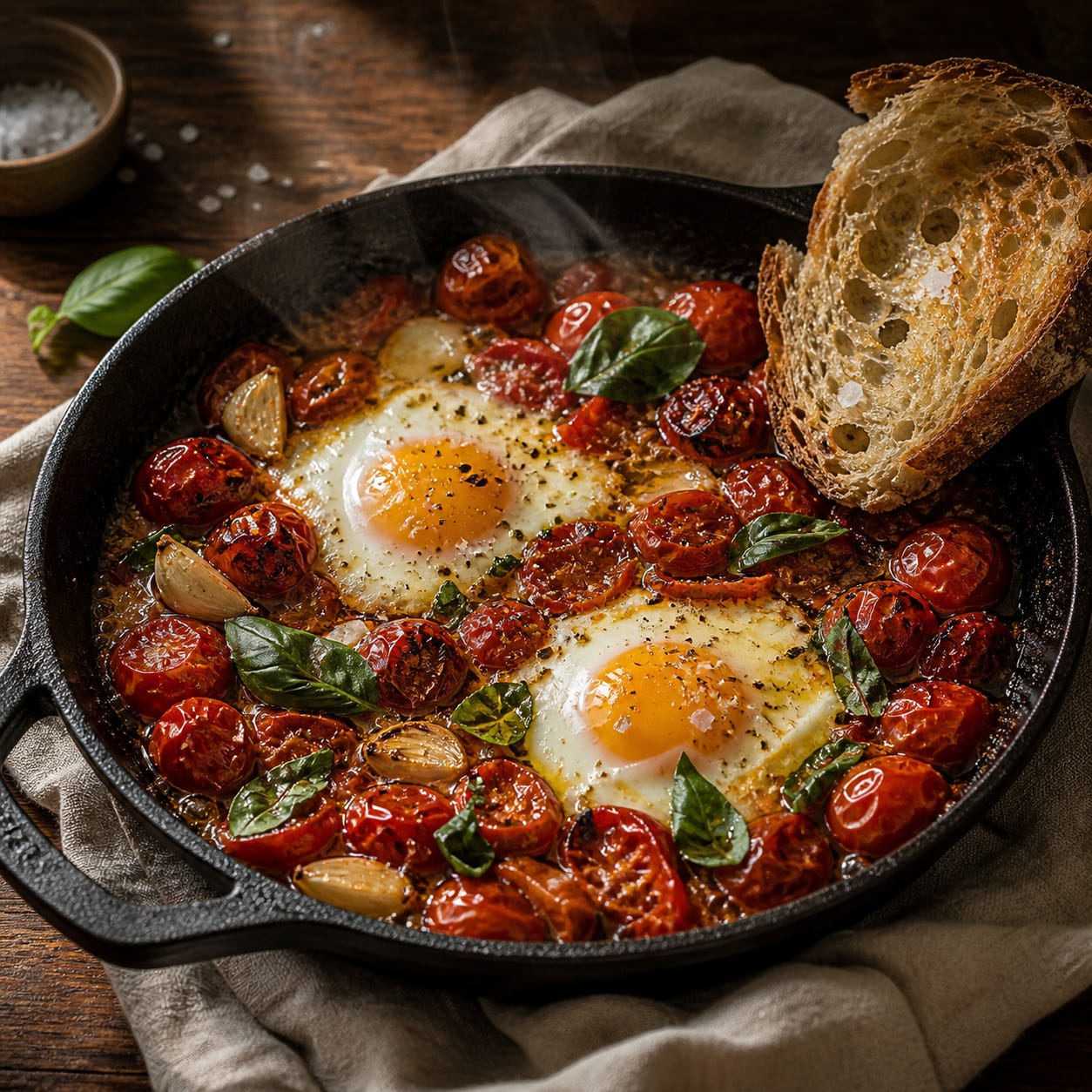
THE RECIPE
Eggs Baked in Slow-Roasted Tomatoes and Garlic
Serves 2 to 3
Ingredients
1 pint cherry tomatoes
4 garlic cloves, lightly crushed
3 to 4 tablespoons olive oil
2 to 3 large eggs
Flaky salt
Freshly ground black pepper
Fresh basil (optional)
Good bread, for serving
Instructions
Preheat the oven to 325°F.
Crush the garlic cloves with the side of a knife and let them sit for about 5 minutes.
Place the tomatoes and garlic in a wide oven-safe skillet or baking dish. Pour the olive oil over everything so the tomatoes are well coated.
Roast for 35 to 40 minutes, until the tomatoes have softened and collapsed into a rich, jammy base.
Remove from the oven and use the back of a spoon to make 2 to 3 small wells in the tomatoes. Crack an egg into each well.
Return to the oven and bake for 10 to 12 minutes, until the egg whites are set and the yolks remain soft.
Finish with flaky salt, black pepper, and fresh basil if you have it.
Serve warm, directly from the dish, with bread to gather the oil, the tomatoes, and the yolk.
Notes from the Pause
Egg yolks are one of the richest sources of choline, a nutrient that supports brain and nervous system function. Most women in the Pause are not getting nearly enough of it. Brain fog is not just tiredness. Sometimes it is the body asking for something specific.
Letting crushed garlic sit for 5 minutes before cooking activates allicin, its most anti-inflammatory compound. That small pause is doing real work.
Slow-roasting tomatoes in olive oil dramatically increases how much lycopene your body absorbs. The fat is not extra. That is the point.
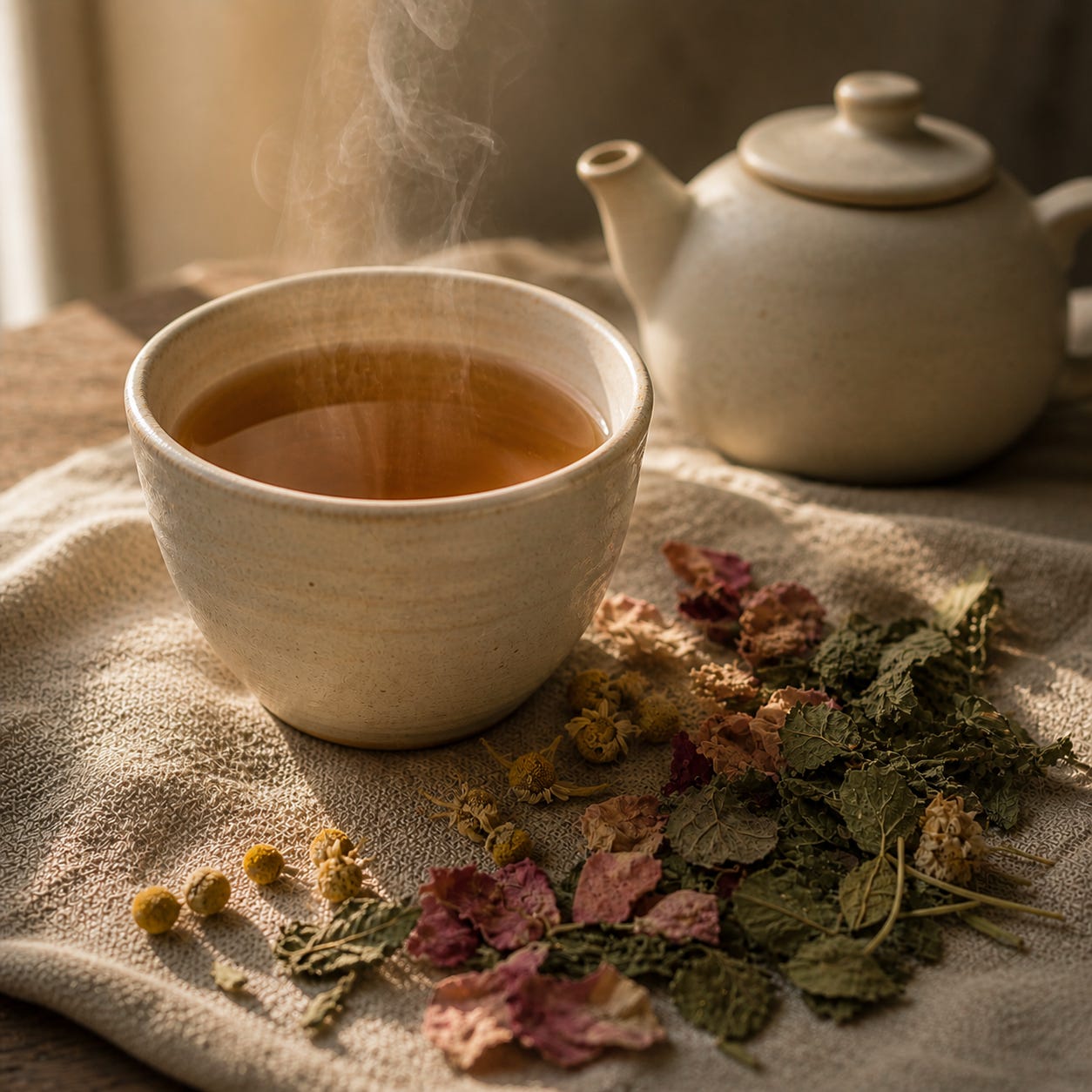
THE SIP
The Soft Landing: chamomile, rose, lemon balm
1 cup
Ingredients
1 teaspoon dried chamomile flowers
1 teaspoon dried rose petals
1 teaspoon dried lemon balm
Instructions
Combine all herbs in a cup or small teapot.
Pour hot water just off the boil over the blend.
Cover and steep for 7 minutes.
Strain and pour into a cup you enjoy holding.
Notes from the cup
Chamomile supports relaxation and helps release the physical tension the body holds without telling you. The shoulders. The jaw. The place behind the eyes.
Lemon balm gently quiets the nervous system. Useful for the kind of anxiety that does not announce itself but sits just below the surface of a perfectly ordinary Tuesday.
Rose has been used for centuries for emotional regulation. It does not fix anything. It softens the edges of whatever you are carrying.
This is not tea for solving the night. It is for the moment when you decide the night is yours now. When the day stops asking something of you, and you are allowed, finally, to put it down. That moment does not always come on its own. Sometimes you have to make it. This is one way to make it.

THE MOVEMENT
A return
Stand with both feet flat on the floor. Take a slow breath in through the nose. On the exhale, let your shoulders drop completely. Notice how far they fall. Notice that you were holding them up without realizing it. Three rounds. That is enough. The body in the Pause carries more than it says. This is a small way of letting some of it down.
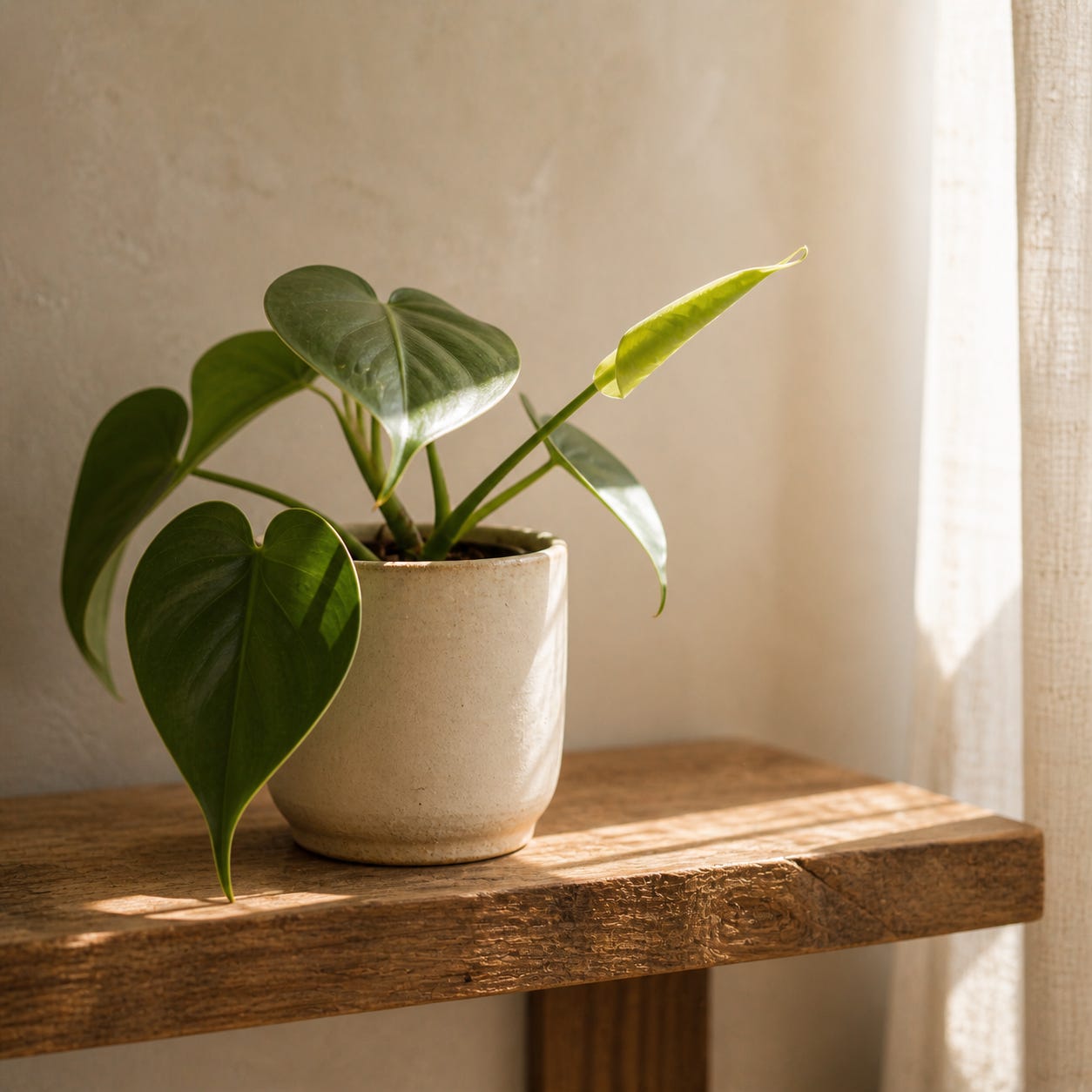
THE HOME TOUCH
One small shift
Move one plant to a different spot. Even a small shift across a shelf or into a new corner. Notice what the light does there at a different hour. You might be surprised by what begins to settle and open when the conditions finally suit it.
A SOFT INVITATION
If something in this landed, I made something for the weeks when your body does not feel like yours. Five permission slips. Small, honest, written in this voice. No protocol. No fixing. Just a little permission to begin somewhere. [It is free, and it is here.]
In The Pause Life arrives every Friday. Written for women in perimenopause, menopause, and post-menopause. Slow, warm, true.
If someone forwarded this to you and you would like to receive it directly, you can subscribe below.
Come sit with me,
Tew Green
In The Pause Life
Transition·Tend·Strengthen·Savor·Become