
What the Pause Taught Me About Pleasure
The slow practice of eating well, alone, on purpose for women in perimenopause, menopause, and post-menopause

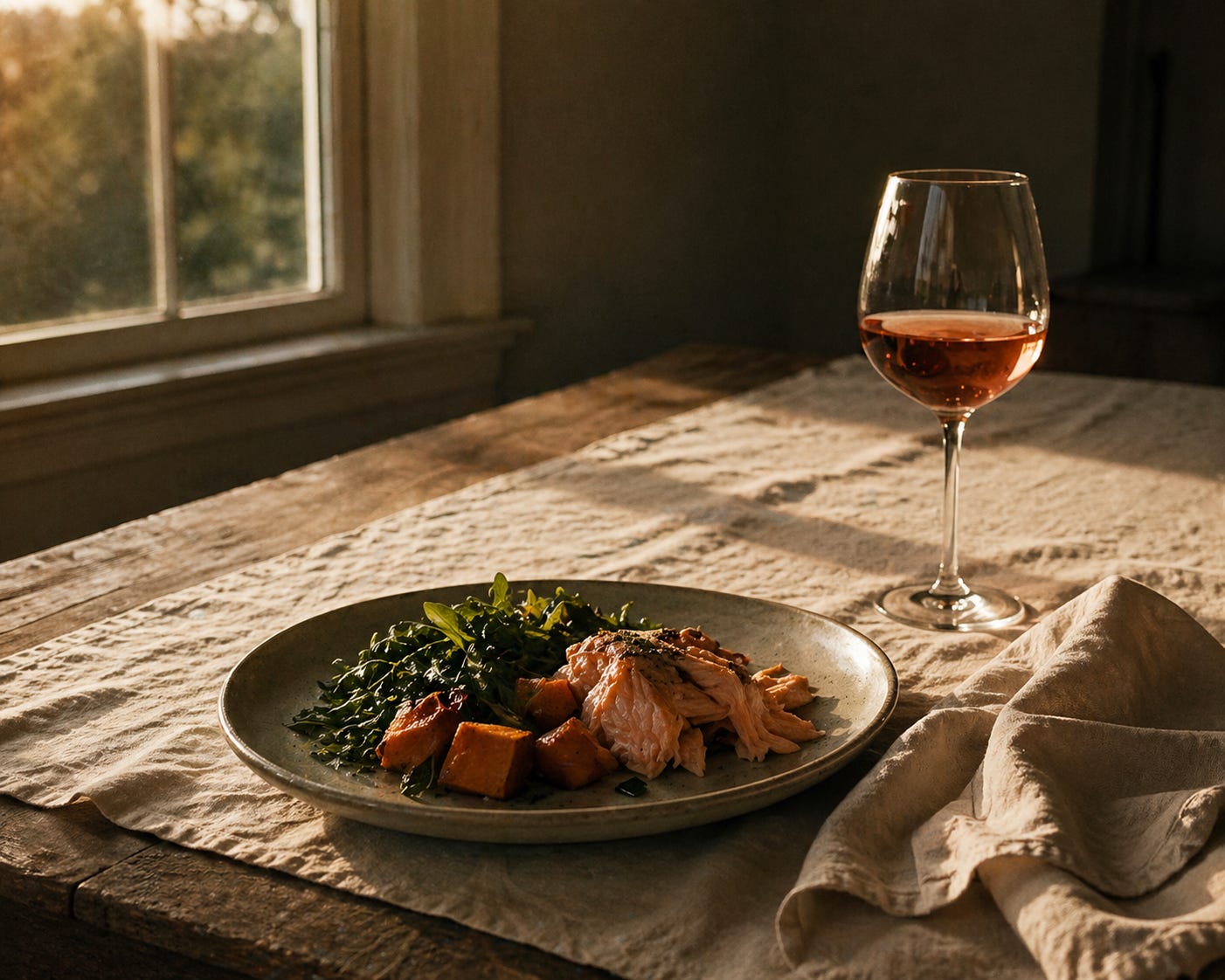
I made myself a proper dinner on a Thursday.
Not a bowl of whatever was fast. Not toast standing over the sink while I scrolled through something I would not remember by morning. A proper dinner: salmon seared until the skin went crisp, sweet potato roasted until the edges caramelized, arugula piled onto a real plate, a glass of wine chosen because I actually wanted it.
I set one place at the table.
And then I sat there, in the quiet, and felt something I did not expect. Not loneliness. Not smugness. Something closer to recognition. As if I had finally shown up somewhere I had been quietly invited to for years and kept declining.
I should tell you what made that Thursday different, because it was not the food.
For most of my adult life, I cooked in relation to someone. A partner, children, a dinner party, a person I was trying to feed or impress or comfort. The meal was a verb aimed outward. Even on nights when I ate alone, there was an apology folded into it. The slightly sad rotisserie chicken eaten over the sink. The leftovers reheated without a plate. The snack-as-dinner because it did not seem worth the effort for just me.
I am not sure when I decided I was not worth the effort.
That is what I have been sitting with since Thursday. Not the dinner itself. The belief underneath it.
Somewhere along the arc of this life, in this body that is changing in ways I am still learning to name, I absorbed the idea that pleasure taken for its own sake needed justification. A reason. An audience. I had become very good at deferring the good things. The nice bottle. The fancy olive oil. The beautiful bowl I was saving for company.
Company that, by the way, I cannot specifically remember arriving for the bowl.
The Pause has a way of surfacing this pattern.
I do not know if it is the hormones shifting, or the particular mathematics of this season of life, or simply that time starts to feel less theoretical and more actual. But somewhere in perimenopause, something in me stopped going along with the deferral. It got impatient with the savings. It started asking, quietly and then less quietly: if not now, when exactly?
I had no good answer.
I used to think pleasure was something you arrived at after the work was done. After everyone else settled, after the deadlines were met, after the body had been sufficiently managed and the house sufficiently ordered. Pleasure was the reward at the end of a list I never quite finished.
The Pause does not have patience for that logic. The body is changing, sleep shifts, energy moves differently through a given day, none of it waits for the list to be done.
And somewhere in learning to work with that, in learning to listen to what this body actually needs rather than push through what it does not want, I started to notice the deferral everywhere.
The good wine. The good bowl. The good Thursday.
All of it saved for something that kept not arriving.
So on Thursday I stopped saving.
I roasted the sweet potato. I seared the salmon. I piled the arugula onto the plate I usually set aside for guests. I opened the wine. I sat down at the table, alone, in the quiet evening, and I ate.
The sun was low and wide over the valley, not dramatic, just present, the kind of light that makes the mountains go soft and blue at the edges and fills everything else with a pale gold that is almost white. I sat in it and ate. I did not read while I ate. I looked at the light. I tasted the food. I finished the glass.
I thought: I should do this more often.
And then, more quietly: I should have been doing this all along.
Not as punishment for the years I did not. More like noticing a door that was always unlocked, that I kept walking past.
The Savor pillar of this newsletter is not really about food or wine or the perfect linen napkin. Those are just the surface. It is about an ordinary moment made deliberate. The sensory life that is available to you right now, in this body, on this particular Thursday in May, if you stop waiting for it to arrive with permission attached.
The Pause is long. Perimenopause alone can stretch across a decade. Menopause. Post-menopause. The whole arc of it. That is a very long time to keep eating over the sink.
The occasion is not coming. You are the occasion.
I am still learning that. I made myself dinner and felt it for twenty minutes before I forgot again.
But twenty minutes is more than I had last week.
That is enough to start.
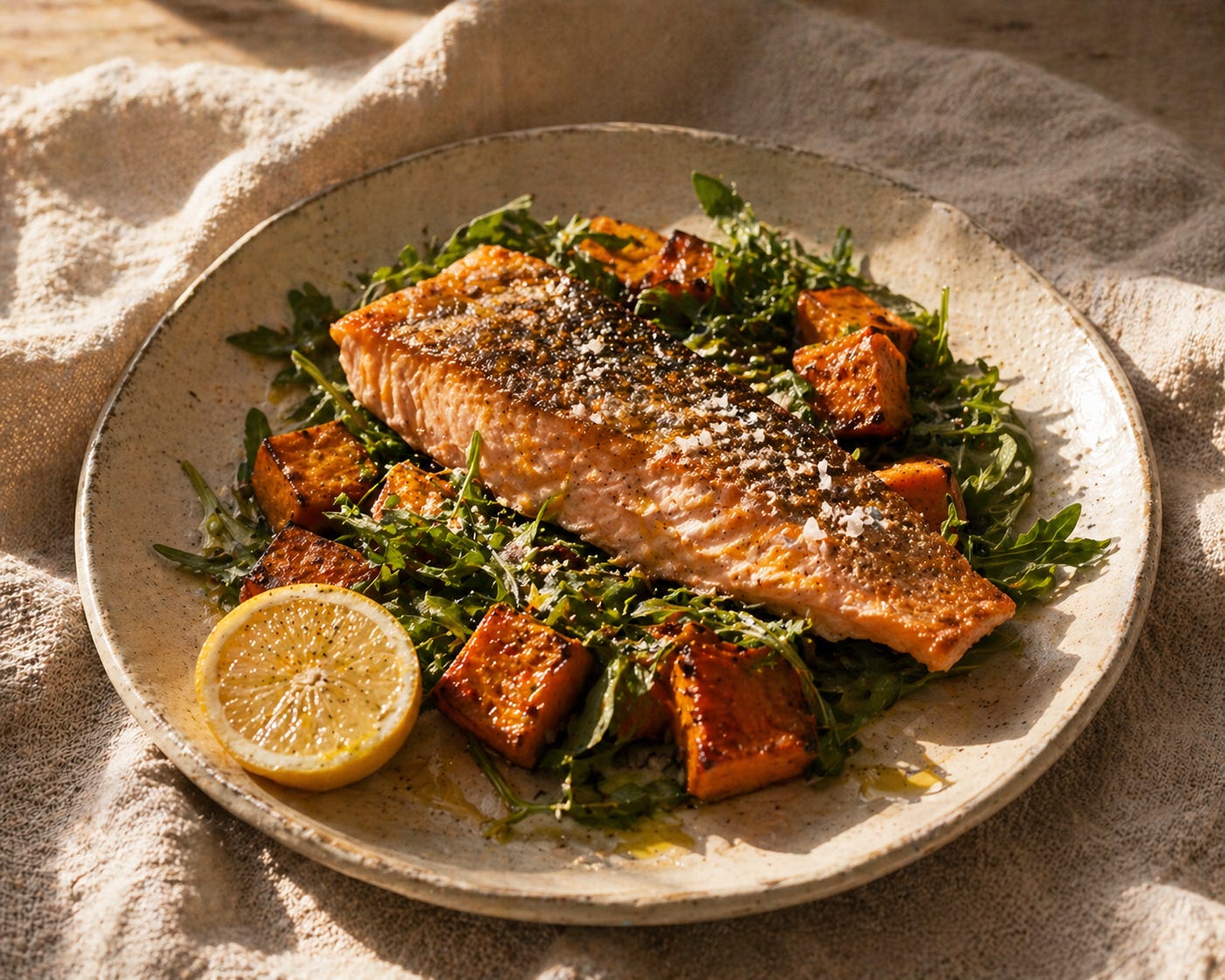
THE RECIPE
Arugula & Sweet Potato Salad with Pan-Seared Salmon
Ingredients
1 small sweet potato, peeled and cubed
1 salmon fillet
1–2 handfuls arugula
Olive oil
½ lemon
Smoked paprika
Salt
Black pepper
Flaky salt (to finish)
Instructions
1. Roast the sweet potato
Preheat the oven to 400°F.
Toss the cubed sweet potato with olive oil and a pinch of salt.
Spread on a baking sheet and roast for about 25 minutes, until the edges are caramelized and slightly crisp.
Set aside to cool to room temperature.
2. Sear the salmon
Season the salmon with salt, smoked paprika, and black pepper.
Heat olive oil in a pan over medium-high heat.
Place salmon skin-side down and cook for about 3 minutes, until the skin is crisp.
Flip and cook for another 2–3 minutes, until just barely done in the center.
Remove from heat and let rest for 5 minutes.
Gently flake with a fork.
3. Build the plate
Place arugula on a plate.
Scatter the roasted sweet potato over the greens.
Lay the salmon on top.
4. Finish
Drizzle with olive oil.
Squeeze fresh lemon over everything.
Add a pinch of flaky salt.
Notes from the Pause
Bitter greens, sweet earth, rich fish, bright acid
Nothing complicated, but everything present
Salmon brings omega-3s that support mood and joints.
Sweet potato brings fiber and steadiness.
Arugula brings that sharpness that wakes the plate up.
You are not eating this because it is good for you.
You are eating it because it is good.
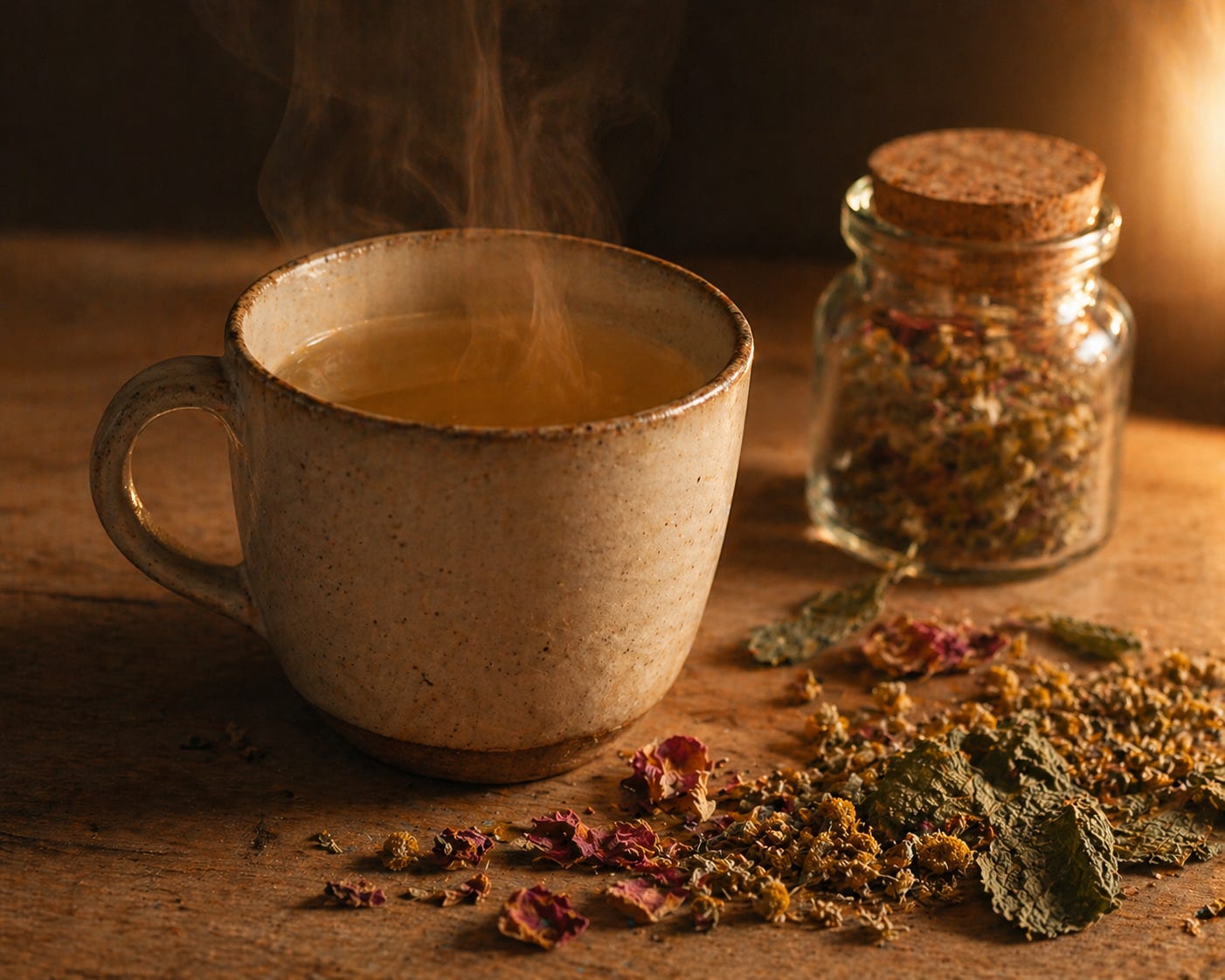
THE SIP
The Pause Evening Blend
Three herbs. Nothing complicated. Just something warm to hold at the end of the day.
Ingredients
1 part dried lemon balm
1 part dried rose petals
1 part dried chamomile flowers
Mix equal parts of each herb and keep the blend in a small jar near your kettle. Somewhere visible. Somewhere easy to reach.
To Brew
Use 1 heaping teaspoon of the blend per cup
Pour water just off the boil (around 200°F)
Cover and steep for 7 minutes
Strain into a cup you actually like using
Notes from the cup
Lemon balm settles the nervous system in a quiet, steady way. The kind of calm that doesn’t announce itself.
Rose softens things. Not dramatically. Just enough to take the edge off a long day.
Chamomile helps the body unclench. It makes rest feel closer, like something you might step into instead of chase.
Together, it tastes like the beginning of an evening that belongs to you.
How to use it
Put the kettle on while something is in the oven.
Pour this first. Before the meal. Before anything else.
No routine. No rules.
Just three herbs, hot water, and a small decision to start gently.
THE MOVEMENT
A slow seat
Before the first bite: sit for thirty seconds without doing anything. No phone, no book, no adjusting. Just be a person in a chair who is about to eat food they made. Feel your feet on the floor. Notice the smell of what is on the plate.
This is not a meditation practice. It is just permission to arrive at your own table.
THE HOME TOUCH
Set your own place
One cloth napkin. A real glass, not whatever is closest. A candle if you have one, not because it is romantic but because flame is interesting and you deserve interesting.
You do not need a dinner party to use the things you have been saving. Use them tonight. For yourself. The bowl does not know the difference. You do.
In The Pause Life arrives every Friday. Written for women in perimenopause, menopause, and post-menopause. Slow, warm, true.
If someone forwarded this to you and you would like to receive it directly, you can subscribe below.
I’ll be here next Friday. Same time, same quiet.
Come sit with me,
Tew Green
In The Pause Life
Transition·Tend·Strengthen·Savor·Become